
Lot 224A
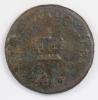
Andrews 720 & Hunt Deacon 7b. Very Rare
-
Notes:
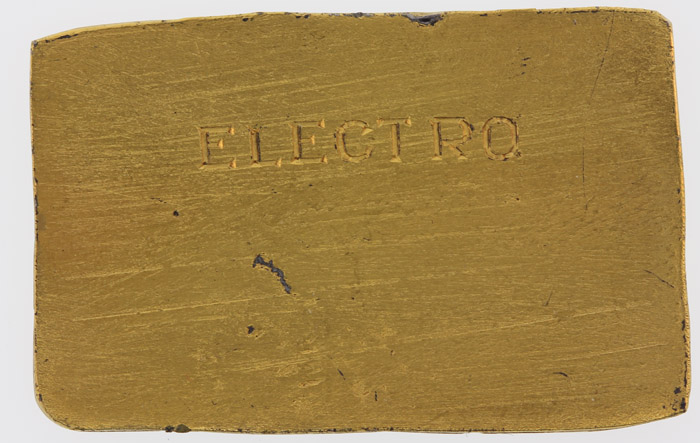
- This new discovery is an early trial struck in copper of an unrecorded type of the NSW 1813 Dump. The coin is generally in good fine condition excepting for surface porosity and design loss as a result of having been buried. The author of "The Holey Dollars of New South Wales", W.D. Mira records in his own collection copper dumps struck on the D2 and E3 dies, and so it was not entirely unexpected that a trial of a 1799 English copper Halfpenny was unearthed in 2007 and subsequently sold for $233,000. This find provided conclusive evidence that copper trials were undertaken by Henshall to 'test the machine(ry)' before the silver dumps and holey dollars were produced. However, this copper trial of the NSW 1813 Dump is of an unrecorded type and is believed to be unique in any metal. The coin differs substantially from the four known types of dumps that are recognised as being struck at 'the Factory' by William Henshall, but it has attributes similar to the A1, D2, E3 and C4 types and appears to be an amalgam of all four. The most observable difference on this coin is the shape of the crown which appears to be taller and also shorter in the base than the styles adopted on the other types. However there is significant evidence of multiple striking on the obverse which may confuse this aspect of the design and there are some similarities to the A1 and D2 types. Certainly the cross of the crown is similar to the A1 and D2 types as are the fleur de lis within the design. The beads in the crown alternate between large and small like the A1 but do not have the usual left to right upward slope associated with this type, and are closer in orientation to the D2 where the beads are centred. Again the multiple striking may obfuscate the underlying design. Like the D2, the cross on the crown points slightly to the left of the 'T' in 'SOUTH', but the 'N' of 'NEW' and the 'S' of 'WALES' fall slightly below the bar of the Crown which is consistent with the re-orientated legend found on the A1 Type. Allowing for the multiple striking, the first two digits of the date are similar to the A1 and D2 types, but the tip of the '1' is missing or lightly struck. The second '1' more closely resembles that used on the E3. There is light evidence of the typical elongated foot of the '3' to the left of an area of design loss, but overall the '3' does appear to be distinct to this new type as the downward bend at the top of the '3' is missing and the two segments of the 3 are separated by a fully formed 'v' which alters the shape of the inner void at the bottom. Certainly the crossing over of the '8' in the date is very pronounced but this has also been observed in high grade examples of the A1. The font on the obverse legend is similar to that used on the A1 and D2's although there are some differences. There is for example some evidence of serifying on the top of the H of SOUTH but this may have been caused by interplay with the edge beading. And like some A1 and D2's , the top of the U in SOUTH is effectively joined, the bottom of the 'E' in 'NEW' is similarly curved and there is serifying on the bottoms of the 'T' and 'H' of 'SOUTH'. On balance it would appear that the letter punches used to produce the obverse dies for these two types were predominantly used to produce this 'Factory Trial'. However some letters particularly the 'E' and 'W' of 'NEW' and the 'L' and 'E' of 'WALES' are a closer match to the E3 Type. The spacing of 'FIFTEEN' and 'PENCE' on the reverse is approximately 4 mm which is closest to the C4 Type and the 'E' of 'PENCE' also finishes closest to the C4 position which dissects the 'N' of 'FIFTEEN'. The second 'F' and the 'T' of 'FIFTEEN' show significant serifying which is also observed on some examples of the C4 Type. This serifying has also been observed on the reverse lettering of some high grade examples of the A1 Type which raised the possibility that perhaps the C4 reverse die may have been used sparingly in conjunction with the obverse of the A1 thus creating a rare fifth A4 Type. However, this appears not to be the case as the letters and spacing do not coincide, but it is evident that the reverse die of the A1 Dump was re-cut very early on with the vast majority of surviving examples having a block type face. It is our opinion that a distinct 'A5' Type with heavy serifying on the reverse letters should now be recognised by the cataloguers. What is apparent with the reverse of this copper trial is that the letter punches used on the C4 Type or this rarer 'A5' reverse are the closest match. This copper trial initially poses a conundrum as it does not appear to have been struck on a readily available English Penny. The contemporary forgeries of the dump are all struck in pure copper and so it can be established were made from the circulating 'Cartwheel' pennies struck at the Soho Mint, but this coin appears on the surface to be considerably less pure and a metal analysis shows a trace of lead. Remnants of the struck surfaces have a silvery look which may indicate that Henshall dipped this copper trial in lead to simulate the look of the silver dumps that were to be struck from the Spanish 8 Reales. Mira notes in his book on Holey Dollars and Dumps that the features of the C4 type show evidence of recutting, and in fact what has been observed as multiple strikes on this copper trial could be similarly described. Perhaps Henshall was reworking the dies of this copper trial to arrive at an end design. The circulated C4 and E3 Dumps have themselves survived only in very small numbers and it is thought that they too were also crude experimental strikings tested on silver, so it would not be beyond reason for these types to have been pre-dated by this unique copper 'Factory Trial.'
Accepted Forms of Payment:
American Express, MasterCard, Money Order / Cashiers Check, Paypal, Visa, Wire Transfer
Shipping
AUSTRALIA: Purchases within Australia will be charged a MINIMUM SHIPPING FEE of $5.50 and will be sent by Registered Post. Additional insurance is optional at the buyer's expense.
INTERNATIONAL: Overseas purchases will be charged a MINIMUM SHIPPING FEE of $20.00 and will be sent by Registered Post International. Additional insurance is optional at the buyer's expense.
Both Australian and International packages are traceable in transit and require a signature on delivery.
Smalls Auctions
You agree to pay a buyer's premium of up to 18.5% and any applicable taxes and shipping.
View full terms and conditions
| From: | To: | Increments: |
|---|---|---|
| A$0 | A$99 | A$10 |
| A$100 | A$999 | A$20 |
| A$1,000 | A$4,999 | A$50 |
| A$5,000 | A$9,999 | A$100 |
| A$10,000 + | A$250 |